Stablecoins Vs. Smart Tensors: The Next Leap in Digital Value
Stablecoins like USDC, USDT, and DAI were the first wave, offering speed and global reach. However, as real-world demands evolved, their limitations became apparent: they lacked true ownership controls, purpose awareness, native compliance, and a truly traceable value structure.
ProofPay solves these challenges not by tweaking the stablecoin model, but by replacing its foundation with a dual-identity architecture — Tensors and Tokens. This design separates what is being moved (Tokens) from how, when, and why it moves (Tensors).
Comparison: Stablecoins vs. ProofPay Tensors
| Feature | Traditional Stablecoins (USDC, USDT) | ProofPay Tensors |
|---|---|---|
| Unit Model | Fungible balances | Individually traceable Tensors |
| Token ID | None | Unique per Token & Tensor |
| Auditability | Limited, wallet-level only | Full Tensor and Token history |
| Freezing/Revocation | Entire wallet | Individual Tensor |
| Usage Restrictions | Not supported | Per-Tensor policies (e.g., food-only) |
| Escrow Logic | Not native | Time, event, or user-locked |
| Offline Verification | Not supported | Via Merkle-proof snapshots |
| Cross-Currency Support | Requires new tokens | Native support (USD, EUR, JPY, etc.) |
| Spend Control | None | $ caps, vendor lock, expiry |
| Ownership Trail | Not possible | Verifiable chain-of-custody |
The Dual-Identity Architecture: A Paradigm Shift
Core Design Philosophy: Individuality vs. Fungibility
Traditional stablecoins operate on a balance-based model. Think of it like a bank account: you see a total balance, but you can’t tell which specific “dollars” make up that sum. They are entirely fungible — one unit is indistinguishable from another.
ProofPay’s system uses a dual-identity model combining Tensors with unique IDs and Tokens with permanent serial numbers pegged to a currency.
Tokens: The Atomic Monetary Units
- Fixed denomination based on currency (e.g., $1.00 for USD)
- Permanent serial numbers (e.g., TX-007100)
- Never destroyed — they only move between Tensors
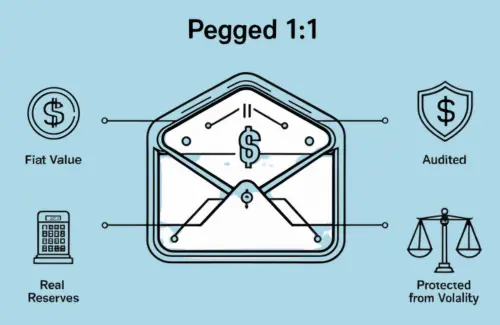
- Immutable value — they provide the unchanging monetary worth
Tensors: The Programmable Envelope
- Unique IDs (e.g., US01H5Z7VG7...)
- Reference Tokens they contain
- Define ownership and permissions
- Carry spending rules, status flags, metadata
- Determine how, when, and why money moves
- Unique IDs (e.g., US01H5Z7VG7...)
- Reference Tokens they contain
- Define ownership and permissions
- Carry spending rules, status flags, metadata
- Determine how, when, and why money moves
| Feature | ProofPay's Tensor-ID System | Traditional Stablecoin System |
|---|---|---|
| Identity | Tokens have serials. Tensors have unique IDs referencing Token ranges. | No individual unit identity; only quantity. |
| Analogy | A smart envelope with numbered bills inside. | A bank account balance. |
| What it Represents | Tensor: How/why/when. Token: What is being moved. | Just the total quantity of value. |
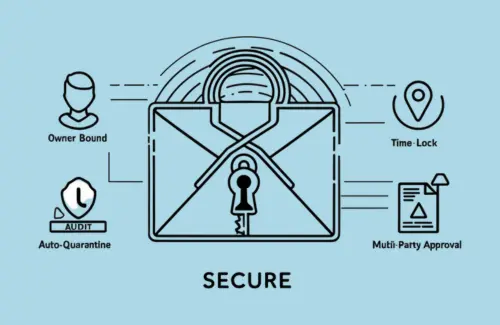
Security and Anti-Theft: Revolutionary Control Mechanisms
The separation of identity and control enables profound advantages.
Conclusion: The Future of Digital Money
Traditional stablecoins were a good first draft. ProofPay Tensors are the blueprint for the future:
- Traceable — Every unit has a complete history
- Programmable — Built-in rules and restrictions
- Auditable — Cryptographically verifiable at all times
- Multi-currency — Native support for global finance
- Compliant — Regulatory-ready from day one
- Secure — Individual unit control and recovery
They don’t just hold value — they enforce rules, prove ownership, and prevent fraud, enabling the programmable, auditable, compliant digital economy of the future.
Disclaimer
All features, functionalities, and capabilities described above are part of the planned ProofPay platform roadmap. Their availability is subject to approval, licensing, or regulatory clearance from relevant government agencies and financial authorities in the jurisdictions where we operate. Certain features may be limited, delayed, or restricted based on regional compliance requirements. ProofPay reserves the right to modify, defer, or suspend any feature until such approvals are fully obtained.
Platform Features